Technical SEO audit
A full crawl covering indexing, redirects, duplicate pages, speed, mobile usability and structured data, delivered as a list ranked by impact and effort.
Organic SEO
Organic SEO services win you places in Google's unpaid results, the listings that aren't ads. We fix what stops search engines reading your site, build pages around what your customers really type, and earn links that give Google a reason to trust you.
A full crawl covering indexing, redirects, duplicate pages, speed, mobile usability and structured data, delivered as a list ranked by impact and effort.
Real searches grouped by what the searcher wants, then mapped so each topic has exactly one page on your site. No two pages fighting over the same query.
Titles, meta descriptions, headings, copy, image alt text and internal links tightened until every page says clearly what it is about.
Service pages, guides and FAQs written from interviews with your team, so they carry real expertise. Nothing is published until you approve it.
Google Business Profile work, consistent business details across directories, review habits and location pages that say something useful.
Links from relevant, reputable sites earned through content, partnerships and outreach. We don't buy links and we don't touch private blog networks.
We crawl the site, read your Search Console data and study who ranks where you want to be.
A quarterly plan of fixes, pages and target searches, ranked by impact and agreed before work starts.
Each month we ship the fixes, publish the content and build authority, in that order of priority.
A plain-English monthly report on visibility, traffic, enquiries and what happens next.
Organic SEO services are the unpaid work of getting a website to rank in normal search results: fixing technical problems, improving pages, publishing content people search for and earning links from other sites. You pay for the work, not for each click, so traffic keeps arriving after the work is done.
Every organic SEO service worth paying for covers the same ground, because search engines need the same three things from any page. They have to be able to reach it, understand what it's about and trust that it deserves a spot. Technical SEO handles the first, on-page work and content handle the second, and links plus reputation handle the third. Skip any one and progress stalls.
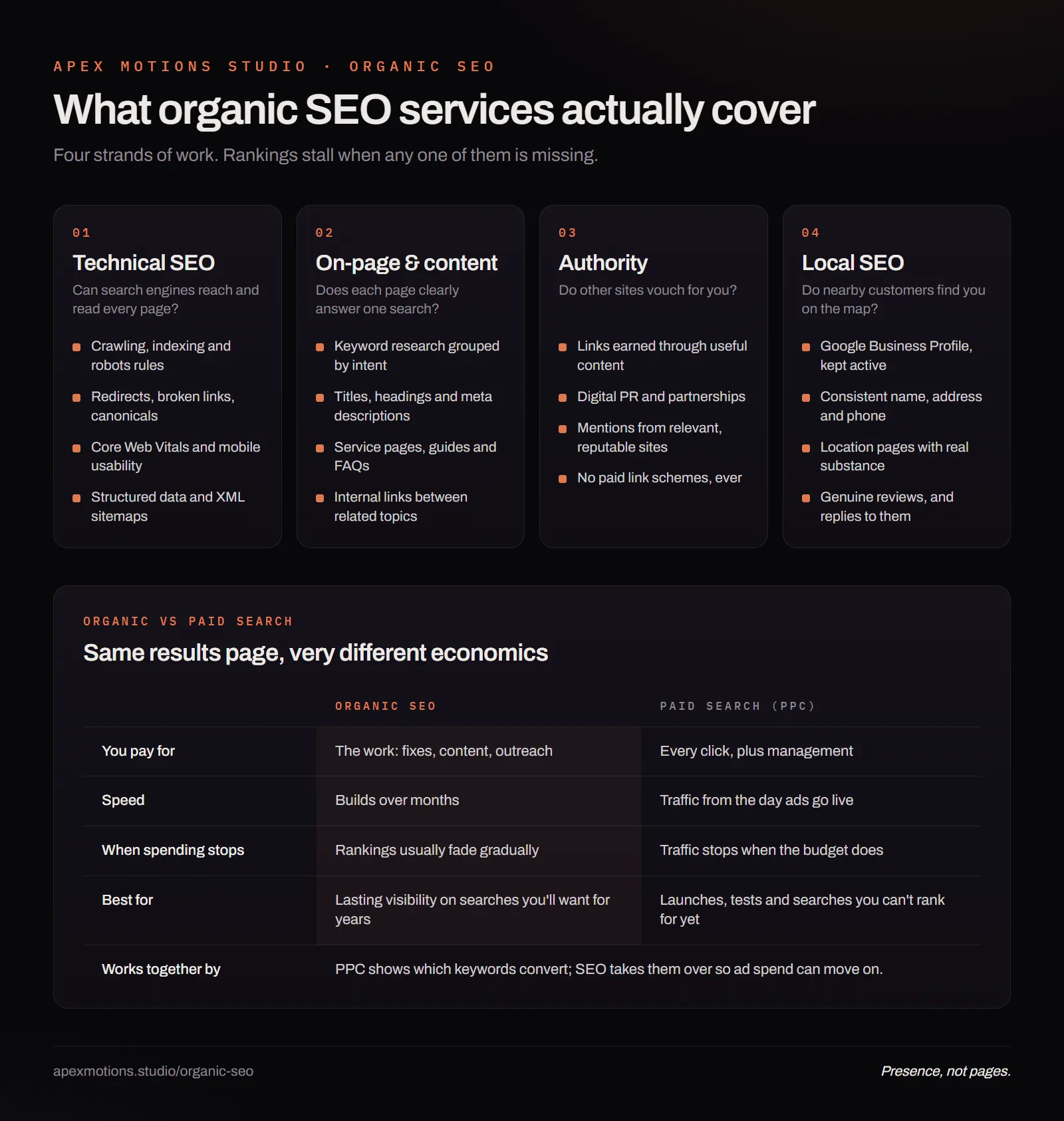
Both show up on the same results page. The difference is the economics. With paid search you buy each click, and the traffic stops when the budget does. With organic SEO you invest in the site itself, results build more slowly, and they tend to hold up when you pause.
The two work better together than apart. Ads show you which searches convert before you spend months chasing them organically, which is why we often pair SEO with the work of our PPC marketing agency team. When a page starts ranking for a term you were paying for, that budget can move somewhere else.
We crawl the whole site the way a search engine would. The audit covers robots rules, XML sitemaps and canonical tags; pages Google has declined to index and the reasons it gives; broken links, redirect chains and soft 404s; near-duplicate pages competing for the same search; Core Web Vitals from real-user data; and structured data. You get it as a ranked list, so the fixes that matter most happen first.
A keyword only matters if the person typing it wants what you sell. We sort searches into researching, comparing and ready-to-buy, then give each group one page. Here's a hypothetical example: a landscaping firm might target "commercial landscaping services" on a service page, answer "how often should a lawn be aerated" in a guide, and go after "landscaper near me" through local SEO. Three intents, three pages, no overlap.
On-page work tightens what's already there. Titles get rewritten to earn the click, headings are put in a sensible order, image alt text describes the image, and internal links point readers and crawlers to related pages. New content fills the gaps the research found. We draft it from interviews with your team because experience is hard to fake, and Google says plainly that it rewards helpful, people-first content.
Links from other sites still act as votes of confidence. The ones worth having come from relevant, reputable places: industry publications, partners, local organisations, people who cite a guide because it's genuinely useful. We earn them through content and outreach. Buying links is cheap until it isn't, because one penalty can undo years of work across the whole domain.
Search engines judge whether a site really knows a subject, not only whether one page mentions a phrase. So we plan content in clusters: a main service page, then the guides and answers that sit around it, all linked to each other. A page about kitchen renovations ranks more easily when the same site also explains costs, timelines and permits, and links those pages together sensibly.
Here's a hypothetical month for a mid-sized service business, three months into the work. The first week goes on fixes from the audit list: a batch of redirect chains, some missing title tags, a slow template. The second and third weeks produce two new pages, say a service page and a guide, drafted from a call with the client's team and approved by them. Alongside that we pitch the guide to a couple of industry sites that would genuinely find it useful. In the last week we read the data, update the plan and write the report.
The balance shifts over time. Early months lean heavily on technical work. Later months lean on content and authority, because by then the foundations are solid.
Our monthly report fits on a page or two. It covers impressions and clicks from Search Console, positions for your priority searches, organic visits and the enquiries or sales they led to, plus what we shipped that month and what's next. If something went down, the report says so and says why we think it happened. You won't get forty pages of charts designed to look busy.
A few symptoms come up again and again. Traffic dropped after a redesign or a platform move. Pages you care about aren't showing in Google at all. Competitors with weaker offers rank above you. Search Console is full of warnings nobody has looked at. Or the site has grown for years without a plan, and nobody's sure which page is meant to rank for what. Any one of those is worth a proper look.
If customers find you by searching for a service plus a place, local SEO decides whether you appear in the map results. That means a complete, active Google Business Profile, the same name, address and phone number everywhere you're listed, a steady flow of genuine reviews (and replies to them) and location pages that say something specific about each area.
We work remotely, and we take on clients in competitive local markets. Businesses looking for SEO services in Texas, whether that's SEO services in Dallas, Houston or Austin, get the same process as a company searching for SEO services in Los Angeles. We don't keep offices in those cities, and we won't pretend to. What a "SEO service near me" search is really after is someone who understands your local market, and that comes from research, not from a street address.
Google's AI Overviews and chat-style assistants pull answers from pages that are easy to read and clearly trustworthy. The groundwork is the same as for normal rankings: clear headings, direct answers near the top of a section, accurate structured data and real expertise behind the words. Nobody can promise a mention in an AI answer. A well-built, well-written site gives you the best odds.
Technical fixes can show up within weeks once pages are recrawled. Rankings for competitive searches usually build over several months. The speed depends on how healthy the site is to start with, how strong the competition is and how much content needs to be written. We'd rather tell you that now than sell you a 30-day miracle.
We quote monthly work after the audit, because the right budget depends on the site. The main factors are its size and technical health, how competitive your searches are, how much new content each month needs, and the reach you want: local, national or international.
Ask any organic SEO services company to show you the work, not just the reports. Who will be doing the fixes? Will the data live in your own Search Console and Analytics accounts? How do they earn links? Be careful with anyone who guarantees first place, sells links by the hundred or won't explain what they changed last month. Our reporting is plain English and you keep every account if we part ways.
Organic SEO marketing services can only do so much on a slow, badly structured site. When the foundations are the problem, our web design company side rebuilds them with search in mind from the first sketch. SEO is one part of what we do as a digital marketing agency, alongside paid search and social.
New content also needs a first audience while it waits to rank, which is where our social media marketing services come in.
They're the unpaid work of getting a site to rank in normal search results: technical fixes, keyword research, on-page improvements, content and link earning. You pay for the work rather than each click.
Technical fixes can lift visibility within weeks. Competitive rankings usually build over several months, depending on the site, the competition and how much content is needed.
It depends on the size and health of the site, how competitive your searches are and how much content you need each month. We quote after the audit, so the budget matches the real work.
Neither is better in general. PPC brings traffic straight away and stops when spending stops. Organic SEO takes longer but keeps paying off. Most businesses do best with both, using ads to learn which searches convert.
A technical audit, keyword research by intent, on-page optimisation, content creation, local SEO where it applies, link earning and monthly reporting.
For businesses whose customers search before they buy, usually yes, as long as you can wait months rather than weeks. If you need enquiries next week, start with paid search and build SEO alongside it.
No, and be wary of anyone who does. Nobody outside Google controls its rankings. We commit to the work, clear targets and full access to the data.
Ask who does the work, whether the data stays in your own accounts and how links are earned. Avoid anyone who guarantees rankings or sells links in bulk, and ask to see what changed on a past client’s site, not only the report.
It helps your odds. AI answers draw on pages that are clear, well structured and trustworthy, which is the same groundwork organic SEO builds. Nobody can guarantee a mention.
Local organic SEO helps you show up in map results and local searches. It covers your Google Business Profile, consistent business listings, reviews and location pages.
Yes. We work remotely with businesses in Dallas and the rest of Texas, in Los Angeles and across the US. We have no local offices there, but the research is done for your specific market.
Always. Search Console, Analytics and every report stay in your accounts, and you keep them if we stop working together.
Custom web design from a small studio: sites planned, designed, animated and coded by the same people, quick on phones and ready for search.
Explore 03A PPC marketing agency for Google Ads, Microsoft Ads and paid social, managed around cost per lead and return on ad spend.
Explore 04Social media marketing services from a studio that animates for a living: strategy, content, community care and reporting tied to real enquiries.
ExploreSend us the address and a line about your goals. We'll come back with a first view of what's stopping it ranking.
Start a project