Discovery and site mapping
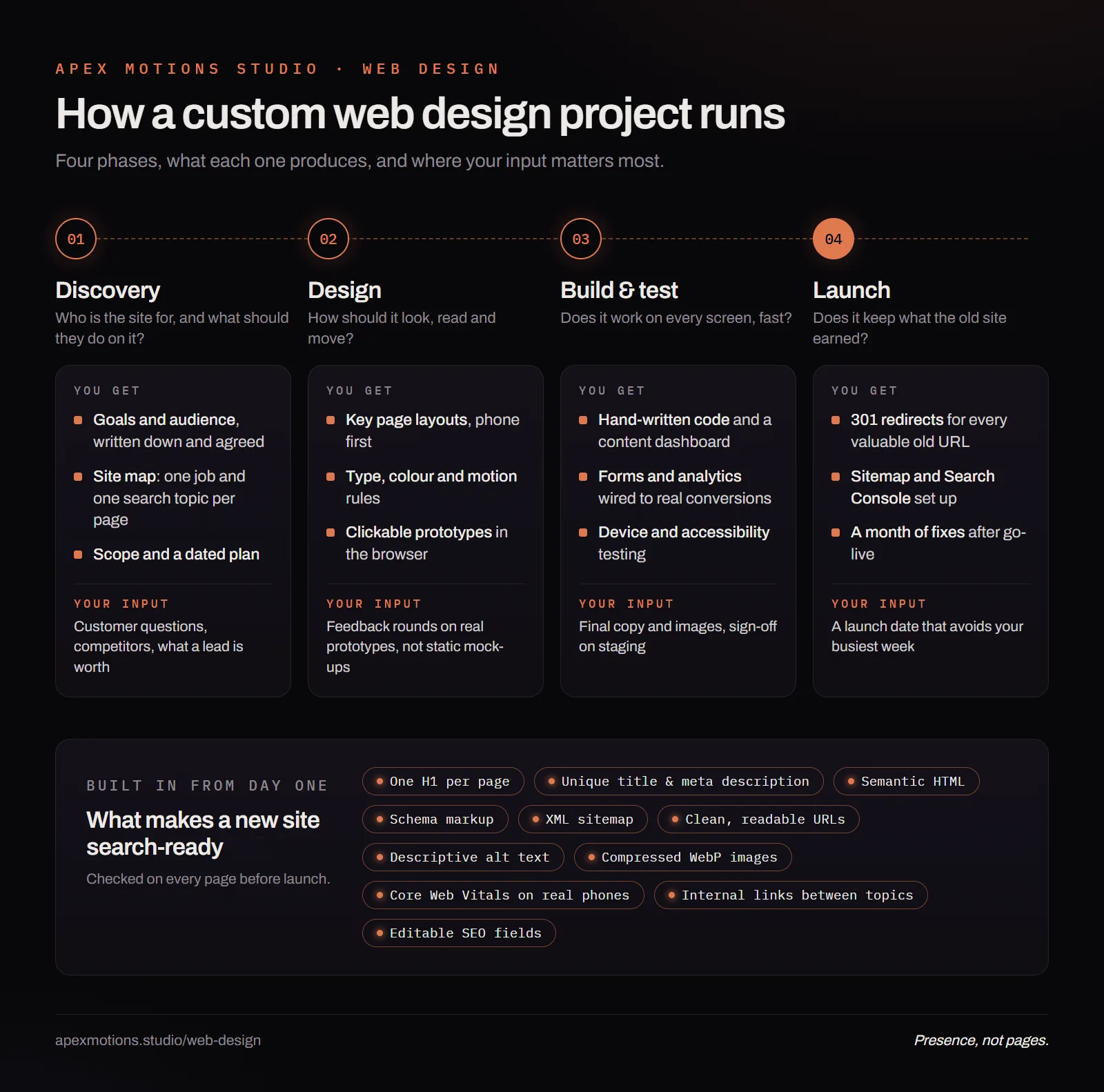
We talk to you, study the competition and draw a page-by-page site map. Every page gets one job and one search topic before anybody opens a design file.
Web design
Web design is where every other channel ends up. Ads, search results and social posts all send people to your site, and the site decides what they do next. We're a small web design company that plans, designs, animates and codes custom websites in-house, so the prototype you approve is the site that goes live.
We talk to you, study the competition and draw a page-by-page site map. Every page gets one job and one search topic before anybody opens a design file.
Layouts, type, colour and imagery designed around your brand and your buyers. No themes, no page builders, and the phone layout is designed first instead of squeezed in at the end.
Scroll-driven scenes and 3D where they explain something, and small interface motion that shows people what just happened. If an effect doesn't earn its weight, we cut it.
Hand-written, semantic code. Forms that actually reach your inbox. Analytics that record real enquiries. Every template is tuned for Core Web Vitals and checked on real phones.
Rebuilding an older site without losing what it earned. Each URL that brings traffic or links gets a planned 301 redirect, and its useful content moves across.
Change copy, images, SEO titles and blog posts yourself. Fixing a typo should take you a minute, not a support ticket.
We agree goals, audience and scope, then hand you a dated plan and a site map to sign off.
Key pages and motion studies are built as browser prototypes you can click through and comment on.
Code, dashboard, forms and analytics go in, and everything is tested across browsers, phones and tablets.
Redirects, sitemap and Search Console are in place on go-live day. Then we spend a month fixing and tuning.
Ask ten people what web design means and you'll hear ten answers. Some picture colours and fonts. Others picture code. For us it's the whole job of deciding what a visitor sees, in what order, and what you want them to do about it. Good web design makes a business easier to understand and easier to choose.
A web designer sorts out structure and appearance: the site map, page layouts, type, imagery and how things move. A developer turns that into working code. In a lot of agencies those are two separate teams who meet at a hand-off. Here the same small group does both, which is why ambitious ideas get tested while they're still sketches and not after you've fallen for a mock-up nobody can build.
All three are legitimate. A template builder is fine for a simple site you'll run yourself. A good freelance web designer can be a great choice for a small, well-defined project. A web design company makes sense once the site has to carry real weight: lots of pages, a brand that competes on how it's perceived, integrations, or marketing that depends on it.
What you're paying an agency for is coverage. Strategy, design, motion, development, SEO and testing all get done by people who talk to each other daily. And because we also run campaigns as a digital marketing agency, the site is built knowing where its traffic will come from.
Every project starts with discovery. We want to know who buys from you, what they compare you against and what a new enquiry is worth. That shapes the site map, where each page targets one clear topic. Skipping this step is the most common reason sites look nice and do nothing.
Design comes next, and we show it as working prototypes in the browser instead of flat images. You see how a page scrolls on a phone, how a menu opens, where the eye lands first. Feedback on a real prototype is faster and more honest than feedback on a picture.
Then we build. That means hand-written front-end code, a content dashboard, forms wired to your inbox, and analytics that count conversions properly. Before launch we test on actual phones and tablets, check contrast and keyboard access, and measure load speed.
Search engines read a site's structure long before any person sees it. Clean URLs, one H1 per page, sensible headings, schema markup and a live XML sitemap are cheap to build in and expensive to retrofit. Every site we deliver is ready for organic SEO services from the first day, whether we run them or you hire someone else.
Launch day is where a lot of that work gets protected or lost. Our website launch checklist lists what we record beforehand and what we check on the day, from redirects to the noindex tag someone forgot to remove.
We like 3D and motion. We also know a heavy page loses people, especially on a phone with a weak signal. So every effect is tuned per device: a desktop on fibre gets the full scene, an older phone gets a lighter one, and text pages such as services and articles stay plain and quick. You can see where we set the bar on our work page.
Speed isn't only about images. We keep scripts small, load fonts carefully, reserve space so the layout doesn't jump, and check Core Web Vitals on real devices before handover.
Pretty doesn't pay for itself. A site earns its keep when a stranger can tell within a few seconds what you do, who it's for and what to do next. So the top of each page states the offer in plain words. Each page has one main action, and it's visible without hunting. Proof sits close to the claim it supports: a project, a process, a name.
Forms ask for what you actually need and nothing else. Phone numbers are tappable. Pricing pages, if you have them, don't make people email to find out roughly what something costs. None of this is glamorous, and all of it shows up in the enquiry numbers.
Accessibility gets bolted on at the end of many projects, which is the expensive way to do it. We design with readable contrast, sensible focus states, real buttons and labelled form fields from the first prototype. Motion respects the reduced-motion setting some visitors switch on. It's the right thing to do, and it also tends to make a site easier for everyone, search engines included.
A good brief is shorter than people expect. We'll ask who your best customers are, what they usually ask before buying, who you lose work to, and what a new enquiry is worth. During the project we need one decision-maker for reviews, timely feedback on prototypes, and access to the current site, domain and analytics. If you have photography and brand guidelines, great. If not, we'll plan for them.
Before you sign with anyone, us included, ask to see live sites they built and test them on your own phone. Ask who will actually design and code your pages. Ask what happens to your rankings during a redesign, who owns the code and accounts at the end, and how you'll edit content after launch. A web design agency that's confident in its work will answer all of that without squirming.
We don't publish prices, because two sites with the same page count can differ hugely in effort. After a discovery call we send a fixed quote with the scope written out. The main things that move the number:
Most of our builds take six to ten weeks from the first workshop to launch. Big content migrations and complex 3D scenes add time. Slow feedback adds more time than anything else, honestly, so we agree review dates in the plan up front.
A redesign is the best chance to fix technical problems and the easiest way to lose rankings you spent years earning. Before we change anything we crawl the old site, list every URL with traffic or backlinks, and map each one to its new home with a permanent redirect. Content that brings visitors gets rewritten and kept, not dropped because it didn't fit the new layout.
Our custom websites suit businesses that win on how they're perceived and whose customers compare a few options before they get in touch: consultancies, product companies, studios, hospitality, property and specialist services. If you need a huge e-commerce catalogue or a one-page brochure, we'll say so and point you somewhere better suited.
We work remotely, with workshops and reviews held over video, which means the "near me" part of "web designer near me" matters less than you'd think. We take on projects for businesses in Dallas and across Texas, in Los Angeles and the rest of California, and anywhere else with a decent internet connection. What matters is that the founders are on your calls, not where our desks are.
A launch is where the climb begins. Paid campaigns need landing pages that match each ad, and since we build both, our PPC marketing agency work and the site share one set of tracking and one design language.
Social content gets the same treatment. When a post does well, it needs somewhere good to send people, and our social media marketing services are planned with the website's pages in mind.
It plans, designs and builds websites. A full-service web design company handles strategy, site structure, visual and motion design, development, testing and launch, so you deal with one team instead of several suppliers.
It depends on the number of unique templates, the content to be produced, any 3D or interactive work and the integrations involved. We send a fixed quote after a discovery call, with the scope written out so nothing is a surprise later.
Most of our projects take six to ten weeks from the first workshop to launch. Large migrations and complex 3D add time, and you get a dated plan before design starts.
Web design decides structure and appearance: the site map, layouts, typography and motion. Web development turns that design into working code. We do both under one roof, so nothing gets lost in a hand-off.
A freelancer can be ideal for a small, clearly defined site. An agency suits larger projects that need strategy, design, development and SEO together, plus someone accountable for the whole thing.
It can if the migration is careless. We list every URL that earns traffic or links, redirect each one to its closest new page and keep the content that ranks, which is how rankings are protected.
No. Each site is designed and coded for the brand, which keeps pages lean and fast. You still get a simple dashboard for everyday edits.
Yes, a lot. Site structure, page speed, headings, URLs and mobile usability all influence how search engines crawl and rank a site, which is why we build those in from the start.
There is no fixed cycle. Redesign when the site no longer reflects the business, is slow or hard to edit, or stops converting. Many sites need regular small improvements more than a full rebuild.
You do. The domain, code, content, analytics and accounts stay in your name, with full access, whether or not we keep working together.
Yes. We work remotely with businesses across the US, including Dallas, the rest of Texas and Los Angeles. Workshops and reviews run over video, and the founders are on every call.
Organic SEO services covering technical fixes, useful content, earned links and local search, for traffic you don't pay for click by click.
Explore 03A PPC marketing agency for Google Ads, Microsoft Ads and paid social, managed around cost per lead and return on ad spend.
Explore 04Social media marketing services from a studio that animates for a living: strategy, content, community care and reporting tied to real enquiries.
ExploreTell us about the business and the site you have in mind. The founders read every message and reply within two working days.
Start a project