Account audit
A look through an existing account for wasted spend, weak structure, missing negative keywords and tracking gaps, before we suggest changing anything.
PPC marketing
PPC marketing buys you a place at the top of the results page today. Whether that place makes money comes down to tracking, account structure, bids and the page people land on. As a PPC marketing agency we handle all four, every week, in ad accounts that stay in your name.
A look through an existing account for wasted spend, weak structure, missing negative keywords and tracking gaps, before we suggest changing anything.
Search campaigns built from keyword research and grouped by intent, with ad copy tested against the current best performer.
Product feeds, asset groups and audience signals for online stores and lead-generation accounts with enough data to scale.
Campaigns on Meta, LinkedIn and TikTok with creative made for each placement instead of one ad resized six ways.
GA4, Tag Manager and each ad platform set up to record the same leads and sales, once each, so automated bidding learns from real results.
Pages written and built for each campaign by the people who design our websites, then tested for conversion.
Conversion tracking is checked and fixed before a dollar of new budget goes out.
Campaigns are structured around your margins, your targets and the searches that actually lead to sales.
Every week: search terms, bids, budgets, ads and landing pages reviewed and adjusted.
A shared dashboard plus a monthly call on spend, results and next month’s plan.
PPC stands for pay-per-click. It's a form of online advertising where you pay each time someone clicks your ad, not when the ad is shown. The best-known version is Google Ads: you bid on searches related to your business, and your ad can appear above or below the normal results, marked as sponsored. The same model runs on Microsoft Advertising, YouTube, and social platforms such as Meta, LinkedIn and TikTok.
PPC marketing is the work of making those clicks profitable. That covers picking the right searches and audiences, writing ads, setting bids and budgets, building landing pages and measuring what each click turns into. Done carelessly, it's a quick way to spend money. Done well, it's the most controllable lead source most businesses have.
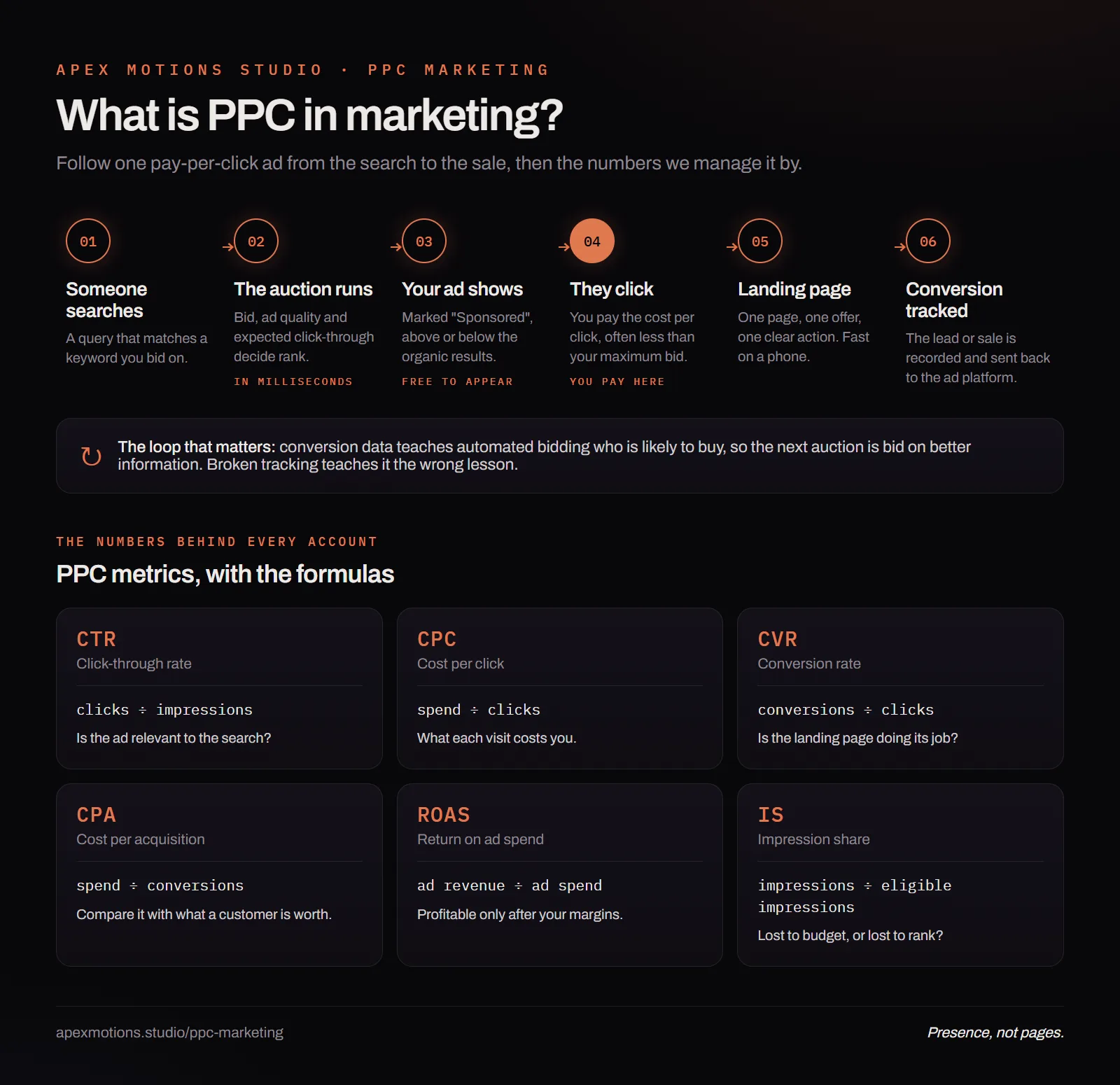
Each time someone searches, the platform runs a quick auction among advertisers bidding on that query. Your bid matters, and so does quality: how relevant the ad is to the search, how likely people are to click it, and how good the landing page experience is. A relevant ad with a strong page can outrank a bigger bid. That's why we spend as much time on ads and landing pages as we do on bids.
Automated bidding is only as smart as the data it gets. Before any new budget goes out we check that GA4, Tag Manager and the ad platforms count the same conversions, that a form submission or call is counted once, and that enhanced conversions are set up where they help. An account optimised against broken tracking gets very good at the wrong thing.
Campaigns are grouped by intent and margin, not by whatever the platform suggested at setup. High-intent searches such as "emergency plumber" get their own budget and their own ads. Research-stage searches get cheaper bids, or none at all. Negative keywords keep out searches that look relevant but never buy.
A PPC account is never finished. Every week we read the search terms report, add negatives, check pacing against budget, test new ad copy and look at results by device, location and time of day. Automated bidding is used where there's enough conversion data for it to learn and kept on a short leash where there isn't.
A negative keyword tells the platform not to show your ad for a search. If you sell premium kitchen installations, you probably don't want clicks from "free kitchen design software" or "kitchen installer jobs". Match types control how loosely a keyword can match a search, and loose matching without negatives is where most wasted spend hides. We review the search terms report every week for exactly this reason.
Most visitors don't enquire on their first visit. Remarketing shows ads to people who've already been on your site, across search, display, YouTube and social. Done gently, with a frequency cap and a message that moves the conversation on, it's often one of the cheapest sources of conversions in an account. Done badly, it follows people around until they resent you.
Sending paid clicks to a generic homepage is the most expensive habit in PPC. Each campaign should land on a page that repeats the promise in the ad, loads fast on a phone and asks for one thing. We design and build those pages ourselves, the same way our web design company team builds full sites, so ads and pages are tested together.
Ad platforms report dozens of metrics. These are the ones that drive decisions. CPA (cost per acquisition) is spend divided by conversions. ROAS (return on ad spend) is ad revenue divided by ad spend. Conversion rate is conversions divided by clicks, and it's often the cheapest lever because a better page lowers CPA without touching bids. Impression share tells you whether you're losing visibility to budget or to ad rank, which call for very different fixes.
Here's a hypothetical example. An account spends $2,000 in a month and gets 40 enquiries, a CPA of $50. If one in five enquiries becomes a client worth $1,500, each client costs $250 in ads. Whether that's good depends on your margins, which is why we set targets from your numbers rather than an industry average.
Paid search answers demand today. Organic search builds an asset that keeps working. PPC data shows which keywords turn into customers, and that tells our organic SEO services where to focus. As rankings take over a search, budget can move to the terms you can't rank for yet.
Search captures demand that already exists. Paid social creates it by reaching people based on interests, job titles or behaviour before they think to search. We use it to introduce a brand, retarget site visitors and push the organic posts that are already doing well, which ties neatly into our social media marketing services.
Your cost has two parts: the media budget you pay the ad platforms, and our management fee, agreed up front and kept separate. Media budget depends on what clicks cost in your market and how many conversions the platforms need in order to learn. Management depends on the number of platforms and campaigns and how much creative and landing-page work is involved. After the audit we propose a starting budget and a plan to scale it.
You're paying for clicks but nobody can say how many became customers. Costs per lead have crept up for months with no explanation. The search terms report is full of queries that have nothing to do with you. Every campaign runs on the same broad settings it had at launch. Or you've never had admin access to your own account. Any of these is a good reason for an audit before you spend another month's budget.
PPC marketing agencies vary a lot, and the differences show up in the details. Ask who will run your account day to day. Ask whether ad accounts will be in your name (they should be). Ask how they decide bids and what they'd change first. Be wary of any PPC marketing company that takes a percentage of spend and then rewards itself by raising your budget, or that reports clicks without showing what those clicks became.
Ads can target a city, a radius or a whole country, so where your agency sits matters less than how well it knows your market. We work remotely with businesses across the US, including Dallas, Houston and the rest of Texas, and Los Angeles. If you searched for a PPC company near me, the useful question is whether that company will run your account with care. We don't have offices in those cities, and we say so.
Paid search is one channel among several. As a digital marketing agency, we plan it alongside SEO, social and the website so each one makes the others cheaper.
PPC, or pay-per-click, is online advertising where you pay each time someone clicks your ad. Google Ads is the best-known example, and the same model runs on Microsoft Ads, YouTube and social platforms.
It plans, builds and manages paid campaigns: keyword and audience research, ad copy, bids and budgets, conversion tracking, landing pages and reporting. The aim is profitable conversions, not just clicks.
It depends on click costs in your market and how many conversions the platforms need to learn. After an audit we suggest a starting budget and a plan for scaling it as results come in.
Ads can bring traffic on the first day. Expect a learning period of a few weeks while bidding settles and we cut the searches that waste money.
Often, yes, if you track conversions and know what a customer is worth. Start with a focused set of high-intent searches and a strong landing page rather than spreading a small budget thin.
There is no universal number. A good target stays profitable after your margins and running costs, so we work it out from what a sale or new client is worth to you.
Not quite. PPC is the advertising model, where you pay per click. CPC, or cost per click, is the metric: what each click actually cost you.
Searches you tell the ad platform to exclude, so your ads do not show for queries that will never convert. Adding them every week is one of the simplest ways to cut wasted spend.
They do different jobs. PPC brings traffic now and stops when spending stops; SEO builds slowly and keeps working. Most businesses benefit from running both.
You do. Accounts, audiences, data and creative stay in your name with full access, whether or not we keep working together.
Yes. We audit it first, keep what works and its history, then fix tracking, structure and wasted spend before making bigger changes.
Yes. We work remotely with businesses in Dallas, across Texas, in Los Angeles and elsewhere in the US, and target campaigns to the exact areas you serve.
Custom web design from a small studio: sites planned, designed, animated and coded by the same people, quick on phones and ready for search.
Explore 02Organic SEO services covering technical fixes, useful content, earned links and local search, for traffic you don't pay for click by click.
Explore 04Social media marketing services from a studio that animates for a living: strategy, content, community care and reporting tied to real enquiries.
ExploreTell us what you spend today and what you need it to bring in. We'll reply with where we'd start.
Start a project